
Your Wedding, Your Way: Personalised Style with Style Studio
Your Wedding, Your Way: Personalised Style with Style Studio Personalising a wedding goes beyond choosing a beautiful ou

By Vasundhara | Published: Jul 17, 2026 | Updated: Jul 17, 2026
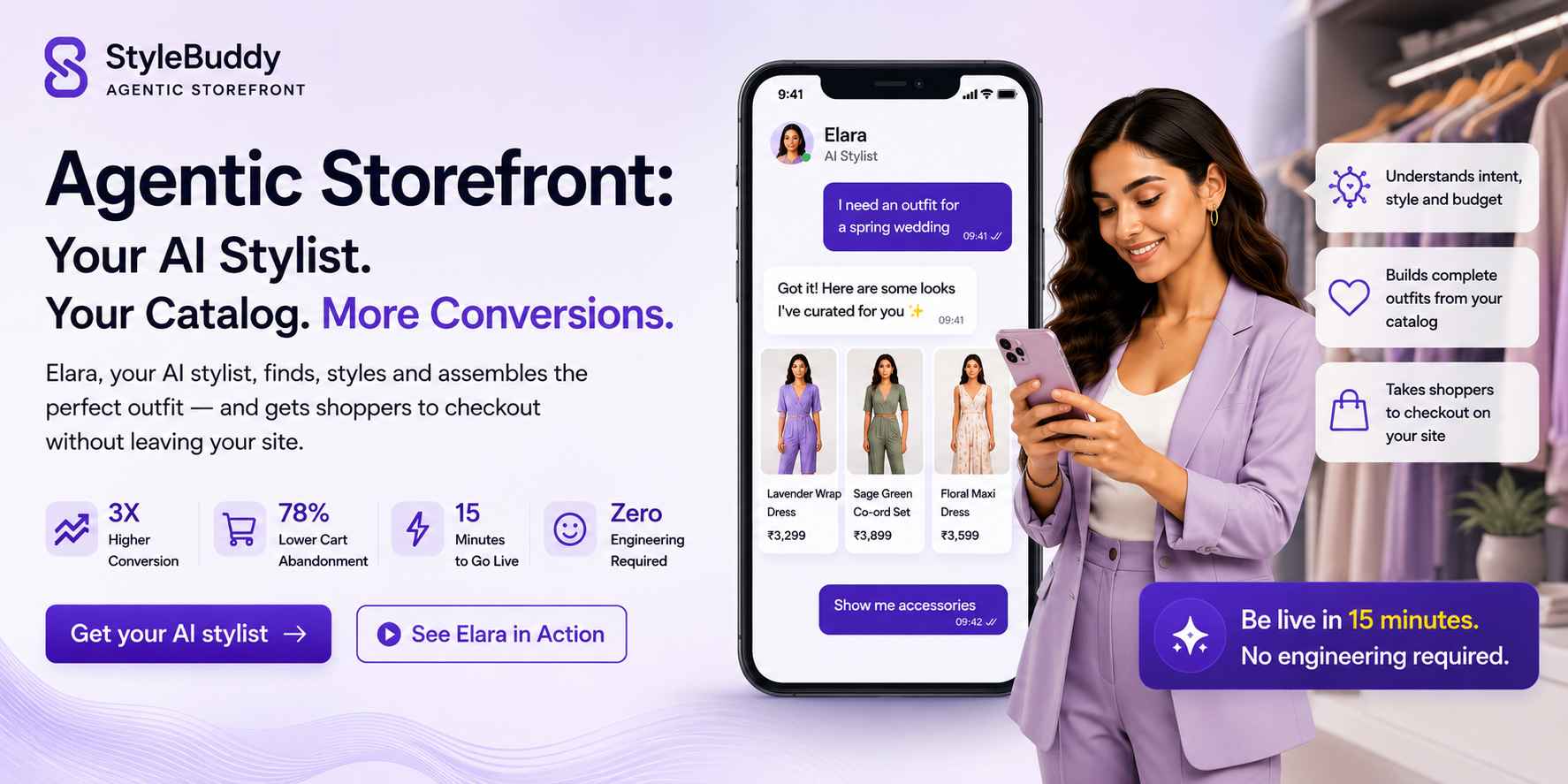
The short answer "Agentic storefront" has quietly become one of the most confusing terms in fashion ecommerce — because it now describes two genuinely different things. One puts your products inside AI chat platforms. The other puts an AI stylist on your own w
Fashion Business & Marketing
Fashion Business & Marketing
Fashion Business & Marketing
Product Updates
"Agentic storefront" has quietly become one of the most confusing terms in fashion ecommerce — because it now describes two genuinely different things. One puts your products inside AI chat platforms. The other puts an AI stylist on your own website. Both are real, both matter, and they solve different problems. This guide draws the line clearly, then helps you work out which one your brand needs first.
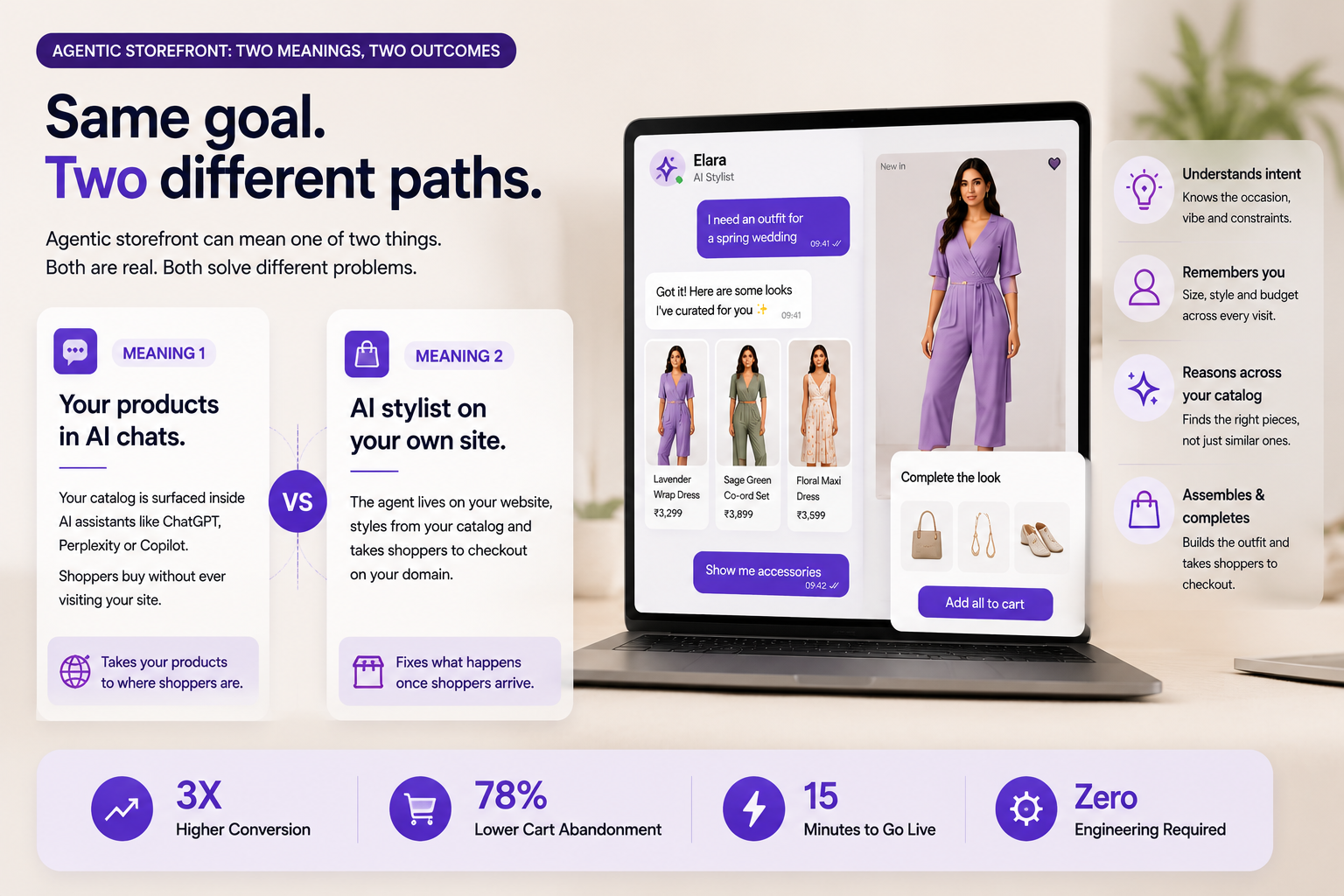
What is an agentic storefront? An agentic storefront is a shopping experience where an AI agent — rather than the shopper — does the work of finding, styling and assembling products. It either operates inside AI assistants like ChatGPT, or sits directly on a brand's own site as an AI stylist that builds outfits from that brand's catalog.
Most articles on this topic pick one definition and ignore the other, which is why brands end up talking past each other. Here's the honest breakdown.
Meaning 1: your products, sold inside AI chats. This is the definition Shopify popularised when it launched its Agentic Storefronts product. Your catalog gets surfaced inside ChatGPT, Perplexity or Copilot, and the shopper buys without ever visiting your site. It's a new channel — separate from your website, your app and your marketplace listings. Industry coverage often notes these tend to run on brand-owned .ai domains.
Meaning 2: an AI stylist on your own storefront. Here the agent lives on your site. The shopper describes what they want, the AI reasons across your catalog, assembles a complete outfit and takes them to checkout — all without leaving your domain. Some vendors call this an AI shopping agent. This is what StyleBuddy's Agentic Storefront does.
The distinction that matters: meaning 1 takes your products to where shoppers are. Meaning 2 fixes what happens once they arrive. Neither replaces the other.
The underlying problem is the same in both cases. A shopper who wants "something for a spring wedding" gets a grid of dresses sorted by price or popularity. No occasion logic. No fit context. No styling. They're left to do the work a shop assistant would have done for them — and often they just leave.
An agent changes the interaction from browsing to asking. Four things separate a real agent from the recommendation engine you probably already run:
A recommendation engine says "customers also bought." An agent says "here's the outfit, in your size, within your budget.
A useful rule: fix conversion before you chase a new channel.
Selling inside ChatGPT is exciting, but it's a channel play — it adds reach on top of whatever your conversion rate already is. If your product pages currently convert poorly and your carts get abandoned, a new channel just pours more traffic into the same leak. Getting an AI stylist onto your existing storefront addresses the leak itself, and it's usually far quicker to deploy.
There's also a practical argument. Industry research on agentic storefronts consistently flags the same two obstacles: data requirements and measuring ROI. An agent on your own site sits inside your existing analytics, so attribution is straightforward. Sales that happen inside someone else's AI assistant are much harder to see.
The good news is that the work overlaps. Structuring your catalog so an AI stylist can reason about it — clean attributes, real fit data, useful descriptions — is the same work that makes your products legible to external AI agents later. Do meaning 2 first; it makes meaning 1 easier.
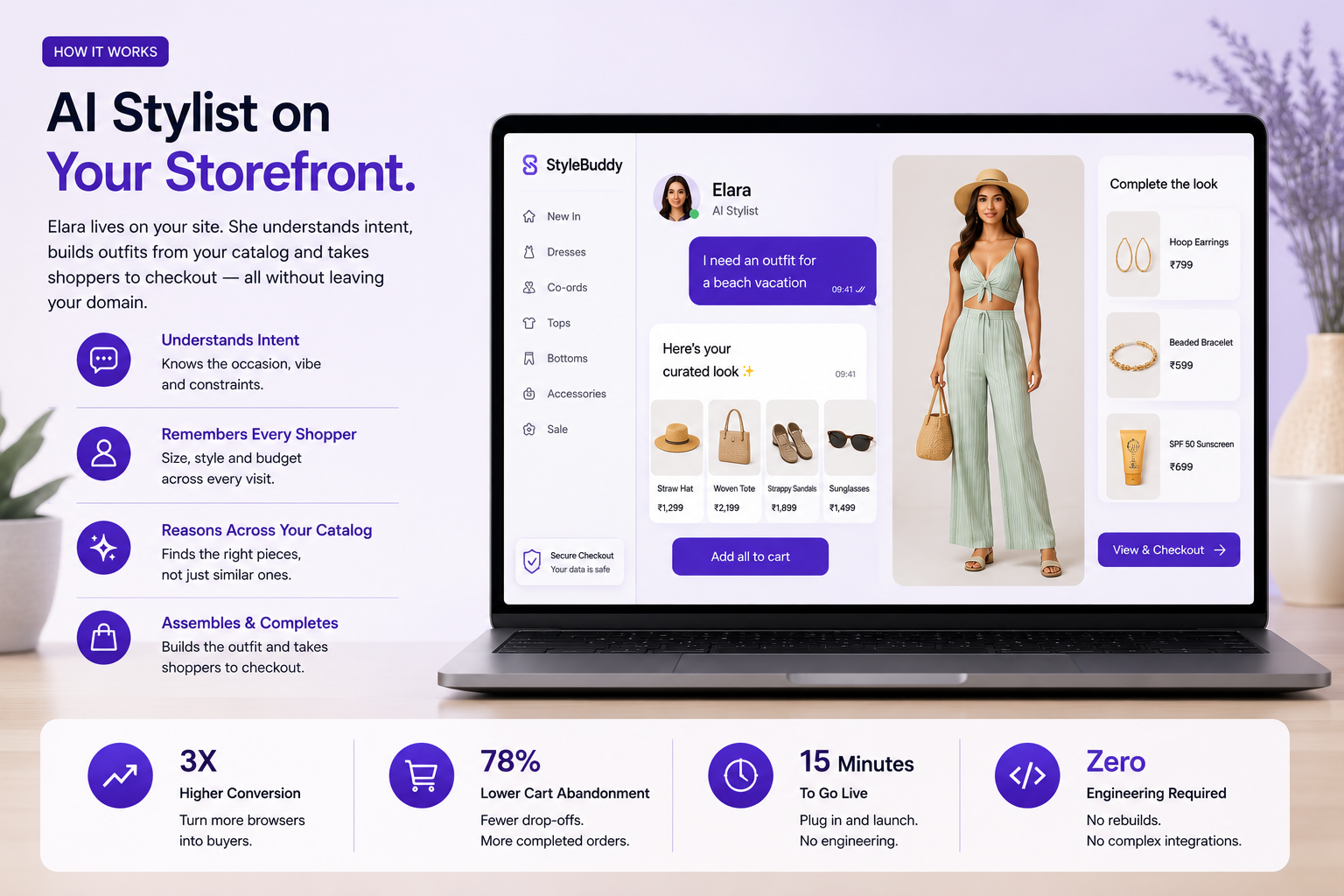
StyleBuddy's Agentic Storefront is Elara — an AI stylist that sits directly on your existing storefront.
Shoppers ask Elara what they're looking for. She builds a complete outfit from your own catalog and takes them through to checkout without leaving your site. There's no rebuild and no new checkout to integrate — she layers onto what you already have.
What brands get:
That last point is the one brands underrate. A stylist who remembers you is the difference between a tool and a relationship — and it compounds every time the shopper returns.
If you want the shopper-facing view of the same engine, our virtual try-on work covers how try-on links let you launch without touching your theme, and Introducing StyleBuddy Virtual Try-On explains why seeing the garment matters as much as finding it.
Whichever meaning you pursue, an agent is only as good as the data it reasons over. Before you deploy anything:
What is an agentic storefront?
An agentic storefront is a shopping experience where an AI agent does the finding, styling and assembling instead of the shopper. The term covers two setups: your products sold inside AI assistants like ChatGPT, and an AI stylist running on your own website that builds outfits from your catalog.
What's the difference between an agentic storefront and an AI shopping agent?
Some vendors reserve "agentic storefront" for selling inside external AI platforms, and use "AI shopping agent" for an agent running on your own site. The terminology isn't settled across the industry, so it's worth asking any vendor which one they mean before comparing products.
How is an agentic storefront different from a recommendation engine?
A recommendation engine pattern-matches past behaviour to suggest similar products. An agent understands intent, remembers the shopper across visits, reasons across your full catalog and can assemble a complete outfit rather than just surfacing lookalikes.
How long does it take to launch an agentic storefront?
It depends which type. StyleBuddy's Agentic Storefront, Elara, goes live on an existing storefront in about 15 minutes with no engineering work, because it layers onto your current site and checkout rather than replacing them.
Do I need to rebuild my website for an agentic storefront?
Not for an on-site AI stylist. Elara sits on your existing storefront with no rebuild and no new checkout. Selling inside external AI platforms is a different exercise and depends on your ecommerce platform's support for it.
The fastest way to understand an agentic storefront is to watch one style a real shopper through your own products. See the Agentic Storefront — or get your AI stylist and be live in 15 minutes.

Hi I’m Vasundhara - I’m a personal stylist and a growth marketer. I’m writing this blog to share thoughts about fashion, styling, technology and StyleBuddy. I’m passionate about fashion in general.
Your Wedding, Your Way: Personalised Style with Style Studio Personalising a wedding goes beyond choosing a beautiful ou

Choosing a wedding dress can feel overwhelming with endless styles, silhouettes, and opinions. This blog explores how St

This blog explores how Style Studio by StyleBuddy helps individuals refresh their wardrobes and embrace new fashion tren

This blog explains how Style Studio by StyleBuddy empowers individuals to build a fresh personal style aligned with the
